《高考英语3500词详解》
VIP免费
2024-12-06
27
0
949.2KB
301 页
5.9玖币
侵权投诉
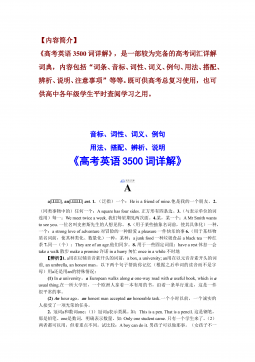
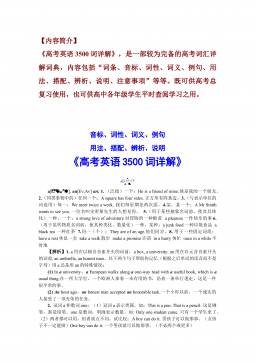
【内容简介】
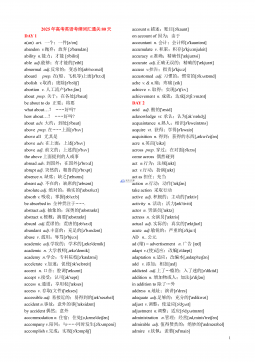
《高考英语 3500 词详解》,是一部较为完备的高考词汇详
解词典,内容包括“词条、音标、词性、词义、例句、用
法、搭配、辨析、说明、注意事项”等等。既可供高考总
复习使用,也可供高中各年级学生平时查阅学习之用。
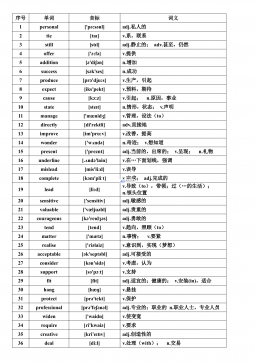
音标、词性、词义、例句
用法、搭配、辨析、说明
《高考英语 3500 词详解》
A
a[], an[] art. 1. (泛指)一个:He is a friend of mine.他是我的一个朋友。
2.(同类事物中的)任何一个:A square has four sides. 正方形有四条边。3.(与表示单位的
词连用)每一:We meet twice a week. 我们每星期见两次面。4.某,某一个:A Mr Smith
wants to see you. 一位名叫史密斯先生的人想见你。 5.(用于某些抽象名词前,使其具体
化)一种,一个:a strong love of adventure 对冒险的一种酷爱 a pleasure 一件快乐的事 6.
(用于某些物质名词前,使其种类化、数量化)一种,某种:a junk food 一种垃圾食品 a
black tea 一种红茶 7.同一(个):They are of an age.他们同岁。8. 用于一些固定词组:
have a rest 休息一会 take a walk 散步 make a promise 许诺 in a hurry 匆忙 once in a while 不
时地
【辨析】1. a 用在以辅音音素开头的词前,a box, a university; an 用在以元音音素开头
的词前, an umbrella, an honest man。以下两个句子帮助你记忆(根据之后单词的读音而不是
字母)用 a还是用 an 的特殊情况:
(1) In a university,a European walks along a one-way road with a useful book, which is a
usual thing.在一所大学里,一个欧洲人拿着一本有用的书,沿着一条单行道走,这是一件
很平常的事。
(2) An hour ago,an honest man accepted an honorable task.一个小时以前,一个诚实的
人接受了一项光荣的任务。
2. 冠词 a和数词 one:(1)冠词 a表示类属。如:This is a pen. That is a pencil. 这是钢
笔,那是铅笔。one 是数词,明确表示数量。如: Only one student came. 只有一个学生来了。
(2)两者都可以用,但着重点不同。试比较:A boy can do it. 男孩子可以做那事。(女孩
子不一定能做)One boy can do it. 一个男孩就可以做那事。(不必两个或更多)
3. 在序数词之前用 the,表示“序数”:When I met her for the second time, she was old.
我第二次见到她时,她老了。 用 a,表示数量或序数的增加:Do you want to read it a
second time? 你还想看第二次吗?
4. most 之前有 the 时,most 表示“最”之意;most 之前有 a时,most 表示“非常”之
意,相当于 very。例如:This is the most beautiful flower.这是最漂亮的一种花。This is a
most beautiful flower. 这是非常漂亮的一种花。
abandon[] vt. 1.抛弃,放弃,戒除:The enemy abandoned they city and
the fled. 敌军弃城逃跑。2.离弃,背弃:The cruel man abandoned his wife and child. 那个狠心
的男人遗弃了妻儿。3.纵情,恣意:He abandoned himself to grief. 他极度悲伤。
【搭配】abandon oneself to 沉溺于;纵情于
ability[] n. 1.[U]能力:She has the ability to speak English fluently. 她能
够流利地说英语。2.[U,C]才能,才智:a man of ability (many abilities) 有才能(多才能)的人
【搭配】the ability to do sth 做某事的能力,一般不说:the ability of doing sth
able[] adj. 有能力的,能够,能干的:He is an able teacher. 他是位有能力的
老师。 He was able to solve the problem quickly. 他很快把问题解决了。
【搭配】be able to do sth 能够做某事
【注意】able 的比较级和最高级通常是 abler 和ablest,也可以是 more able, better able
和 most able,但不如前者常见。
【辨析】be able to 与can 的区别,见 can。
abnormal[]adj. 反常的,不正常的,变态的:abnormal behavior 反常的
行为。This warm weather is abnormal for February. 在2月里,如此温暖的天气不正常。
aboard[] adv.& prep.上船(飞机、车),在船(飞机、车)上:Welcome aboard
this flight to London. 欢迎搭乘本班开往伦敦的飞机。He has gone aboard (the plane). 他上了
飞机。
board n.木板;v.上船(车、飞机)
abroad adv.在(到)国外
broad adj.宽阔的
abolish[] vt.终止,废除:It was Abraham Lincoln who abolished slavery in
the United States. 正 是 亚 伯 拉 罕 ·林 肯 废 除 了美 国 的奴 隶 制 度 。Bad customs should be
abolished. 坏的风俗应当废除。
abortion[] n.[C,U]流产,堕胎:His attempt proved to be an abortion.他
的企图没能得逞。It will cause [produce] abortion. 这将引起流产。
about[] prep. 1.在…各处,到处:He traveled about the world. 他周游了全
世界。2.在…附近(周围):He looked about him now and then. 他不时地环顾四周。3.关于,
涉及:He talked about his family. 他谈到了他的家人。4.在…身上(边):Do you have a lighter
about you? 你身上带有打火机吗? 5.从事于:What are you about? 你在干什么?adv. 1.大约,
差不多:She is about fifty.她大约50 岁。2.在周围,到处:I am used to going about alone.我
习惯于独来独往。3.在附近:There was nobody about.附近没有人。
【搭配】1.How [What] about… …怎么样:How about having a cup of tea? 喝杯茶怎么
样? What about that matter the other day? 早几天的那件事怎么样了? 2. be about to do sth 即将
要做某事(不与具体的时间状语连用):They are about to start. 他们就要动身了。
【辨析】1.about 与 on(关于):about 指泛泛地或非正式地论及某事;on 则指比较系统
地或理论性较强地论述某事。比较:He wrote a book on mathematics. 他撰写了一本有关数
学的书。He wrote a report about this school. 他报道有关这所学校的情况。
I have told you much about the matter. You’d better read a book on it.关于这个问题我已说
了很多,你最好读一本论述它的书。
2. know sb 认识某人,know about sb 知道某人的情况;hear sb 听到某人(讲话),hear
about sb 听说过某人;write a book 写书,write about a book 写书评
above[] prep. 1.高于,高出,在…上方:I saw the moon above the roof. 我看见
月亮在屋顶上。We were flying above the clouds. 我们在云层上面飞行。2. 超过,胜过:
Health is above wealth. 健康胜过财富。The temperature has been above the average recently. 近
来的气温一直比平均温度高。3.不屑于,不至于,不会:He is above doing such things. 他不
至于做出这样的事来。adv.在上面,在前面:the plan mentioned above 上述计划。adj.上面
的:the above statement 如上所述(= the statement above)
【搭配】above all 首先,尤其是 above oneself 自高自大, 自命不凡above sea level 海
拔above the average 一般以上
【辨析】above, over, on:over 表示垂直在上的正上方,与 under 相对,而 above 则不
一定表示正上方,与 below 相对,以上四个词跟物体都不接触。on 表示在上面,与 beneath
相对,跟物体接触。若含有动态或覆盖的意味,通常用 over,而不用 above:He flew over
to France. 他飞到了法国。 Cover the baby over with a sheet. 用床单把婴儿盖起来。
abroad[] adv. 到(在)国外:He just came back from abroad. 他刚从国外回
来。He has been abroad many times. 他多次出国。
【搭配】at home and abroad 在国内外 be all abroad 感到莫名其妙;离题
abrupt[] adj. 1.突然的,意外的:The train came to an abrupt stop. 火车突
然地停了下来。2.(举止、言谈等)唐突的,鲁莽的:He has an abrupt manner. 他举止粗鲁。
3.陡峭的;险峻的:an abrupt peak 一处险峰
absence[] n.[C,U]1.不在,缺席:Her absence was noticed by the teacher. 老
师注意到了她缺席。 In the absence of the manager I shall be in charge. 经理不在的时候,我
将负责。2.[U]缺乏:The police were delayed by the absence of information about the crime.警
察由于未掌握犯罪情报而延误了行动。3.[C]缺席的时间,外出期间:After an absence of
seven years I went home.外出 7年后我返回故乡。
【搭配】absence of mind 心不在焉 in the absence of(某人)不在时,(某物)缺乏
时
absent[] adj. 1.缺席的,不在场的:Nobody is absent today. 今天没人缺席。
2.(作定语)心不在焉的;出神的:He looked at me in an absent way.他茫然地看着我。3.缺乏
的:This idiom is absent in that dictionary.那本词典里没有这个习语。vt.不到,不参与:He
absented himself from the meeting.他没有出席会议。
【搭配】be absent from 不在某处 absent oneself from 本人不参与,没参加 absent-
minded 心不在焉的。
【注意】表示“不在家”时,通常不用 absent,而用 out, not in, not at home, away from
home 等。
absolute[] adj. 1.十足的,地道的:an absolute fool 十足的傻瓜 2.绝
对的,完全的:That’s absolute nonsense! 那完全是胡说。3.确实的,肯定的,无疑的:We
have absolute proof. 我们有确凿的证据。4.无条件的:make an absolute promise 无条件答应。
absorb[] vt. 1.吸收:Dry sand absorbs water. 干沙吸水。2.汲取,理解
(知识等):I have no time to absorb what he said.我没有时间弄懂他所说的话。3.吸引…的
注意,使全神贯注:He is absorbed in study. 他专心学习。4.把…并入,并吞,同化:Most
little shops have been absorbed into big businesses. 大多数小店已被并入大公司。
【搭配】be absorbed in...全神贯注于……
abstract[] adj. 1. 抽 象 的 : We may talk of beautiful things, but beauty
itself is abstract. 我们尽可谈些美的事物,但美本身却是抽象的。 2.抽象派的:an abstract
painter 抽象派画家 n.1.[C]抽象派艺术作品 2.[C]摘要,梗概:Please write an abstract of this
scientific article. 请写一份这篇科学论文的摘要。
absurd[]adj. 荒谬的,愚蠢的,可笑的:It’s absurd not to wear a coat in such
cold weather. 这么冷的天气不穿外衣,真是荒唐。It is absurd to believe that the number 13
brings bad luck. 相信数字 13 会带来恶运是荒诞不经的。
abundant[] adj.丰富的,充裕的:an abundant harvest 大丰收 Our
country is abundant in natural resources. 我国自然资源丰富。
abuse[] v.1.滥用:He was accused of abusing his position for personal gain.
有人指控他以权谋私。2.辱骂,虐待:It’s said that he abused his wife. 据说他虐待他妻子
n.[]1.[C,U]滥用,妄用。2.[C,U]辱骂,说坏话,侮辱
【搭配】the abuse of drugs 滥用药物 personal abuse 人身攻击
academic[] adj. 1.(学院或大学)教学的,学术的:academic research
学术研究 an academic degree 学位 2.纯理论的;不切实际的:an academic point 一个纯理论
的观点。n. [C]大学学生,大学教师
academy[] n. 1.(高等 )专科院校:an academy of music 音乐 院校 a
military academy 军事院校 2.研究院,学会:the Academy of Sciences of China 中国科学院
accelerate[] v.(使)加速,促进,增加:I accelerated and left the
other cars behind. 我加速行驶,其他的车子抛在后面。I decided to accelerate our advertising.
我决定增加广告量。
accent[] n. 1.[C,U]口音,腔调:He speaks with a strong Shanghai accent.他
说话带有很重的上海口音。2.[C]重音:The word “lady” has its accent on the first syllable. lady
这个词的重音在第一个音节。3.[C,U]强调,重点:In all our products the accent is on quality.
在我们的所有产品中,最重视的就是质量。
accept[] v. 1.接受:She offered him a lift and he accepted (it). 她请他坐她
的车,他就领情了。2. 同意,录取:The news that he had been accepted to Beijing University
spread quickly.他已被北京大学录取的消息迅速传开。 3.认为,承认:accept sth as true 信以
为真
【辨析】accept 与receive:前者指主观上的“接受”,后者指客观上的“收到”:He
received the gift, but he did not accept it. 他收到这件礼物,但没有接受。
【搭配】accept…as… 认为…是…
access['ækses]n.[U]1.接近,进入:You can easily get access to him.你很容易见他。2.通
道,入口(后接介词 to):the access to a building 进入大楼的通路。3.(接近、进入或享
用)的机会:Only high officials had access to the Emperor.只有高级官员才可以接近皇帝。vt.
存取(计算机文件):I accessed three different files to find the correct information.我存取了三
个不同的文件以寻找正确的信息。
【搭配】have/gain access to 可以获得/接近
accessible[ək'sesəbl]adj.1. 可到 达的 ,可 接近的, 可进入的: These documents are not
accessible to the public.公众无法看到这些文件。2.容易理解的,易懂的:His poems are always
very accessible.他的诗总是通俗易懂。
accident[] n.1.[C]事故,意 外事 件: Two people were injured in the
accident. 这次事故中有两人受伤。2.[C,U]意外;偶然:It is quite an accident.这是一件很偶
然的事。The police found the lost kid by accident.警察无意中找到了那个失踪的孩子。
【搭配】by accident (=by chance) 偶然地,无意中 by accident of 因为……的机会,由
于……的运气 without accident 平安无事地
【辨析】accident 与 incident:前者指偶然发生的不幸事件(事故);后者则指普通的小
事件,也指暴力性的政治事件:About ten people were killed in the car accident. 在这次车祸
中大约有10 个人丧生。 The book is about the July 7th Incident. 这本书是关于七七事变的。
accommodation[] n. 住处,住 宿 ,膳 宿 :Can we find
accommodation(s) at a hotel for tonight? 我 们 今晚能找到旅 馆 住 宿 吗? / This hospital has
accommodation(s) for 500 patients. 这家医院有500 个床位。
【注意】该词在英国英语中不可数,在美国英语中通常用复数,但不能与不定冠词连
用。
accompany[] v.1. 伴 随 ,陪同:She accompanied her friend to the
concert. 她陪同朋友去听音乐会。2.为……伴奏:Her mother accompanied her on the piano.她
的母亲用钢琴为她伴奏。
【注意】1.该词不接不定式的复合结构作宾语,不可说:He accompanied her to go to
the station.(to go 应去掉) 2. accompany 的真正意思是: to go somewhere with someone,
especially to look after them,所以该词不表示呆在某处陪伴某人。
accomplish[] vt.做成功,完成,达成:accomplish one’s purpose 达到
目的 / We tried to settle the argument but accomplished nothing. 我们试图解决争端,但没起什
么作用。
【辨析】accomplish, complete, finish 与achieve
accomplish 指成功 完成预 期的 目标、任务等,其后常接 task,aim,journey 等名词;
complete 强调事情被完整地完成或终结,含有使某事完善、完整,补足缺少部分的含义;
finish 多指日常事情的完成或结束,其后常接动名词;achieve 多指排除困难完成宏伟计划
或大业。
according [](只用于以下两个习语中)according to: prep.按照,根据:
Everything went according to plan. 一切按计划进行。According to the weather forecast, we'll
have rain tomorrow. 根据天气预报,明天会下雨。according as: conj. 根据……而定,按照…
…而定:You will be praised or blamed according as your work is good or bad.将依照你工作的
好坏对你进行奖惩。
【注意】according to 后一般不接 view(看法)和 opinion(意见)这类词,也不接第一人称
的代词(me, us)。如:依我看,这部电影很不错。
In my opinion, the film is wonderful.(正)
According to my opinion, the film is wonderful.(误)
According to me, the film is wonderful.(误)
account[] n. 1.[C]账目,账户:open an account at [with] a bank 在银行开
户 Put it on my account.= Add it to my account. 记在我的账上。2.[C]描述,说明,报导:I
believe that is a very good account of what happened. 我相信这对发生的情况作了很好的描述。
3.[U]原因,理由:He is angry on this account. 由于这个原因他很生气。4.[U]考虑:Never
leave this point out of account. 绝不可将这一点不列入考虑。
v. 认为:I account him lucky. 我
认为他很幸运。
【搭配】account for 解释,说明 by [from] all accounts 据说,据报道,据各方面 on
account of 因为,由于on all accounts [on every account] 总之 on no account 绝不take
account of 考虑,重视 take sth into account 考虑,注意
accountant[] n. [C] 会计 师 ,会计:He signed the accountant to
enter. 他示意叫会计进去。
accumulate[] v.积累,收集,积储:Dust soon accumulates
in the room. 房间里很快积满了灰尘。 He accumulated a good library. 他积累了丰富的藏书。
accuracy[] n. [U]准确,精确:firing accuracy 命中率 / with accuracy
准确地 / There is no need to check the accuracy of the report. 没有必要核实这份报告的准确性。
accurate[] adj.准确的,正确无误的:Is that clock accurate? 那钟准吗? /
He is accurate in his judgment. 他的判断正确无误。
accuse[] vt.指责,控告,指控:He accused her of cheating. 他指责她作弊。
/ He was accused as an accomplice. 他被指控为同犯。
【注意】表示因某事而控告、指控、指责某人,通常用 accused sb of (doing) sth,其中
的介词 of 不能改为 for:The police accused him of theft [stealing]. 警方控告他偷盗。
accustomed[] adj. 习惯的,经常的:He is accustomed to hard work. 他
习惯于苦干。/ She was accustomed to getting up early. 她习惯于早起。
【说明】表示习惯于做某事,通常用 be accustomed to,其中的 to 通常被认为是介词,
后接名词或动名词,但在现代英语中,其后也可接动词原形(即 to 被视为不定式符号)。
ache[] n.[C,U]疼痛:I have an ache in the stomach. 我胃痛。vi. 痛:His back aches.
他背痛。/ I’m aching all over. 我全身都痛。/ Her head ached all night. 她的头整夜都疼。
【辨析】ache 与pain:前者主要指肉体局部持续的疼痛或隐痛;而 pain 的应用范围则
较广,可指轻微的痛或剧烈的痛,可指局部的痛或全身的痛,可指持续的痛或突发的痛等。
achieve[] vt. 1.达到,取得:He achieved good results. 他取得了好成绩。/
She achieved no success. 她没有获得成功。2.完成,实现:I’ve achieved only half of what I
hoped to do. 我仅完成了我所希望完成的一半。
【说明】通常用作及物动词,偶尔用作不及物动词,表示“获得成功”或“如愿以
偿”: He achieved because he worked hard. 他因为工作努力获得了成功。
achievement[] n.1.[U] 完成:Such a goal was impossible of
achievement. 那样的目标不可能实现。2.[C] 成就,功 绩 :Landing on the moon was a
remarkable achievement. 登上月球是一大伟绩。
acid[] n.[C,U]酸 adj.1.酸的,有酸味的:Lemons have an acid taste. 柠檬有酸
味。2.尖刻的:acid remarks 刻薄话
acknowledge [] vt.1.承认:acknowledge one’s fault 认错,赔不是 / I
acknowledge the truth of his statement. 我承认他 说 的 是 事 实 。 2.(公)认为 : He was
acknowledged to be [as] the best player. 他被公认为是最佳选手。
acquaintance[] n.1.[C]相识的人,熟人:He is not a friend, only
an acquaintance. 他不是朋友,只是相熟。/ He has many acquaintances. 他交友很广。2.[U](可
连用 a)熟悉,熟知:I have some acquaintance with the Russian. 我懂一点儿俄语。
acquire[] vt.1. 获得,取得:She acquired a knowledge of the English by
careful study. 她认真学习而精通英语。2.拥有,得到:Our company has recently acquired a
new office building in Chicago. 我们公司最近在芝加哥得到了一栋新办公楼。
acquisition[] n.1.[U]获得:He devotes his time to the acquisition
of knowledge. 他把时间花在获取知识上。2.[C]得到的东西,得到的人:This motor-scooter
is my latest acquisition. 这辆摩托车是我最新购置的。
acre[] n.[C]英亩:a farm of 20 acres 占地20 英亩的农场 / The total area of a
soccer field is about two acres. 一个足球场的总面积大约为两英亩。
across[] prep.1.穿过,到…的另一边:There is a bridge across the river. 河的
两边有桥相连。2.在…的另一边:The bus stop is just across the street. 公共汽车站就在街道
的那边。3.表示“交叉”:He sat there with his arms across his chest. 他坐在那儿,两臂交叉
放在胸前。adv. 1.穿过,跨过,从一边到另一边:Can you swim across? 你能游到对岸去吗?
2.交叉:He sat there with his arms across. 他交叉着手臂坐在那儿。
【辨析】across 与 through:前者指在面上穿过,后者指在里面或在一定空间范围内穿
过:walk across the playground 走过操场 / walk through a forest 走过森林
【说明】across 用作介词或副词,不能用作动词,cross 才是动词:go across a bridge 过
桥 / cross a bridge 过桥
act[] n.1.[C]行为,行动,举动:It’s a foolish act. 那是愚蠢之举。2.[C]法令,条例:
Social Security Act 社会保险条例 / under this Act 根据本条例 3.[C](戏剧的)一幕:a play of
two acts 两幕剧 v. 1.行动,做事,举止:Think before acting. 三思而后行。/ It’s time to act.
该采取行动了。2.表演:He acts well. 他戏演得不错。3.担任,充当:A trained dog can act as
a guide to a blind person. 经过训练的狗可作盲人的向导。4.起作用,生效:The medicine acts
on the heart. 这药对心脏起作用。5.扮演:He acted (the part of) Hamlet very well. 他扮演哈姆
雷特(这个角色)很出色。■1. act as 充当,起…的作用:He acts as director of the workshop.
他担任车间主任。2. act for 代理,代表:The chairman is ill, so I’m asking Mr Smith to act for
him. 因为主席有病,所以我请史密斯先生代理。
active[] adj.积极的,活泼的,活跃的: active measures 积极措施 / The
market is active. 市场活跃。/ Although he is quite old, he is still very active. 他虽然老了,可仍
闲不住。
【说明】在 take part in(参加)这一短语中,part 前通常不用冠词,但若有了 active 的修
饰,则要用不定冠词:He takes an active part in school activities. 他积极参加学校各项活动。
activity[] n. 1.[U]活动(性),活力:The house has been full of activity
all day. 房子里整天都很热闹。 2.[C]行动,(具体)活动(常用复):school activities 学校活动 /
social activities 社会活动 / sports activities 体育活动 / outdoor activities 户外活动
【说明】侧重指一种繁忙或充满活力的状态时,不可数;侧重指具体所做的事情,如
工作、娱乐、消遣等,则可数,且通常用复数。
actor[] n.[C](男)演员:actor’s lines 台词 / a film actor 电影演员
【说明】actor 指男演员,也可泛指男演员和女演员,要专指女演员,用 actress。
actress[] n.[C]女演员:a famous actress 著名女演员
actual[] adj. 实际的,真实的,现实的:in actual life 在现实生活中 /
actual price 实价 / I’m not joking. These are his actual words. 我不是开玩笑,这都是他的原话。
【说明】通常不用作表语,且没有比较等级。
A.D.[] n.公元:Buddhism was introduced into China about A.D.67. 佛教是
在公元67 年传入中国的。/ From 30 B.C. to A.D. 20 is 50 years. 公元前 30 年到公元20 年之
间有50 年。
【说明】A.D.放在年代之前或之后均可。比较:B.C.(公元前)通常应置于年代之后。
Ad[] n.[C]广告。参见 advertisement。
adapt[] v. 1.使适应,使适合:Can you adapt (yourself) to the new job? 你能
适应这新的工作吗? 2.改编,改装:The car was adapted for use as a taxi. 那辆车已改装成计
程车。/ It is difficult to adapt this story for the film. 要把这故事改编为电影不容易。
【说明】adapt to 意为“适应”,其中的 to 是介词:Soon they adapted to living in the
country. 他们很快就适应了在乡下住。
adaptation[] n.1.[C] 改编本 : an adaptation of a novel for
television 改编小说成电视剧本 2.[U]适应:a period of adaptation 适应期
add[] v. 1.加,增加:Add some water. 加点水吧。/ That was adding fuel to the fire. 那
是火上加油。2.接着说(或写):I have two points to add. 我有两点补充意见。3.加起来,增加,
做加法:The child can’t add yet. 这小孩还不会做加法。■1. add in 包括:Don’t forget to add
me in. 别忘了把我也算上。2. add to 增加:This adds to our difficulties. 这增加了我们的困难。
3.add up 加起来:You haven’t added the figures up right. 这些数字你没有加对。4. add up to 加
起来等于,总之就是…:The figures add up to 500. 这些数字加起来等于 500。/ Your long
answer just adds up to a refusal. 你的冗长回答简直等于拒绝。
addicted[] adj.沉溺于,醉心于:He was addicted to all sorts of vice. 他
无恶不作。/ He was addicted to poetry and hoped to be a poet. 他醉心于诗歌,希望能成为诗
人。
addition[] n1.[U]加,附加,加法:The boy is still not good at addition. 这
个小男孩加法仍然不好。2.[C]增加物,附加物:They’ve got a new addition to the family. 他
们家又多了一位成员。■1. in addition 另外,加之:You need money and time, in addition,
you need diligence. 你需要金钱和时间,此外,你还要努力。2. in addition to 除…外(还):In
addition to English, he has to study a second foreign language. 除了学习英语之外,他必须学习
第二外语。
address[] n.1.[C]住址,通讯处:a return address 回信地址 / change one’s
address 改变地址 / What’s your home address? 你的住宅地址是哪儿?2.[C]演说,致辞,讲
话:Who will give the opening (closing) address? 谁致开(闭)幕辞? vt.1.(在信封等上)写收件人
的姓名地 址:The letter is addressed to you. 这封信是写给你 的。 2. 称呼:How should I
address her? 我该怎样称呼她?
【说明】1. 询问某人的地址时 , 通常说 What’s your address? 不说 Where’s your
address? 当然,若说 Where do you live? 则完全可以,且更通俗。2.用作动词时,无论表示
哪个意思,均及物,后接宾语时,不要误加介词,如要表示给某人致辞,不说 address to
sb,而说 address sb。
adequate[] adj. 1.足够的:The supply is not adequate to the demand. 供
不应求。2.恰当的,胜任的:I hope you will prove adequate to the job. 我希望你能胜任这工
作。3.尚可的,差强人意的:Your work is adequate but I’m sure you could do better. 你的工作
表现不错,但我肯定你还能够做得更好。
【说明】一般不与 enough 连用,以免语义重复。
adjust[] v.1.调整,调节,校正:I must adjust the watch; it is slow. 我必须
把表调一下,它走慢了。2.(使)适应:He soon adjusted (himself) to her way of life. 他很快适
应了她的生活方式。
【说明】表示“适应”时,主要用于 adjust oneself to 这一结构,其中的反身代词可省
略。
adjustment[] n. [C,U] 调 整 ,调 节 ,适应:I’ve made a few
adjustments to the plan. 我对计划作了些小小的调整。/ She made a quick adjustment to her new
job. 她很快就适应了新的工作。
administration[] n.[U]经营,管理,施政, 行政:
You will need some experience in administration. 你需要管理方面的经验。/ Master of Business
Administration (=MBA) 工商管理学硕士
admirable[] adj.令人钦佩的,值得赞赏的:an admirable example of
good planning 一个周详计划的范例 / His behavior was admirable. 他的行为令人钦佩。
admire[] vt. 钦佩,赞美,羡慕:I admire his bravery. / I admire him for his
bravery. 我羡慕他的勇敢。/ His cleverness was much admired. 大家都佩服他的聪明。
【说明】其后不接双宾语或 that 从句,即不说 I admire him his bravery.或I admire that
he is brave.
admission[] n. 1.[U]准入,接纳,入学:Admission by ticket only. 凭票
入场。/ He has the requirements for admission into the university. 他具备了进入该大学的条件。
2.[U]入场费,入学费:Admission to the lecture is $10. 听演讲入场费为10 美元。3.[C]承认,
招供:He made a full admission of his crime. 他全盘招供他的罪行。
admit[] v.1.承认:Dare he admit his mistake? 他敢承认错误吗? / This meant
admitting defeat. 这就意味着承认失败了。2.接纳,招收:They are all admitted to college. 他
们都进了大学。3.让…进入:Each ticket admits two people to the party. 每张票可供两个人入
场参加聚会。■admit of 容许:It admits of no other explanation. 这不容作其他解释。
【说明】 1. 表示“ 承认做了 某事”时,其 后通常接 动名词, 但不接不定式:She
admitted having seen us. 她承认看到过我们。2.通常及物,有时也可不及物,后接介词 to:
He admitted (to) stealing. 他供认了偷盗。3.表示“允许…进入”时,不接不定式的复合结构,
即不说 admit sb to enter a place 之类的。
adolescence[] n.[U]青春期(指童年与成年之间的过渡期):during
(one’s) adolescence 在(某 人 的 )青 春 期 / sex education of adolescence 青 春 期 性 教育 /
Adolescence is often a difficult time in one’s life. 青春期常常是人生中一个困难的阶段。
adolescent[] n.[C]青少年,少男,少女:the problem of adolescents
青少年问题 adj.青春期的,青少年的,少男的,少女的:adolescent problems 青少年问题,
青春期问题
adopt[] vt.1.收养,领养:adopt a child 收为养子 2.采取,采用:They
adopted our methods. 他们采用了我们的办法。
【说明】1.adopt 表示“收养”时,指法律意义上的正式收养,如指一般的认养,则用
foster。2.汉语中的“养子(女)”说成英语是 adopted son (daughter),但是“养父母”却是
adoptive parents / adoptive father / adoptive mother。但若用 foster(adj.)则没有此区别:a foster
child(养子),a foster father(养父)
adore[] vt.1.爱慕,敬爱,崇拜:He adores his parents. 他敬爱父母。2.
非 常 喜欢:He adores (going to) the cinema. 他 非 常 爱 看 电 影 。/ She adores going to the
volleyball match. 她非常喜欢看排球比赛。
【说明】表示“非常喜欢”时,后接动词要用动名词(不用不定式)。
adult[] n.[C]成年人:This novel is suitable for adults. 这本小说适合成年人
看。/ Admission for adults is three dollars. 成人入场费是3美元。adj. 成年的,成熟的(只作定
语):adult life 成人生活 / adult education 成人教育 / adult movie 成人电影
advance[] v. 1.前进,进展:advance in one’s studies 学业进步 / The
work didn’t advance at all. 工作一点 没有进展。2. 提 升 ,上涨:advance in price 涨 价 /
advance in one’s position 职位晋升 3.推进,促进:advance the growth of wheat 促进小麦的生
长 4.提早,提前(日期):The date of the meeting was advanced from 10 to 3 June. 会议日期已
由6月10 日提前到 6月3日。 n.[C,U] 前进,进展,进步:stop the enemy’s advance 阻止敌
军前进 / China has made great advances in industry. 中国在工 业 方 面 进步很大。■1.in
advance 事先,提前:The rent must be paid in advance. 租金必须预付。2. in advance of 在…
前头:He is far in advance of his class. 他在班上遥遥领先。
advantage[] n. 1.[C]优点,优势,好处:It is a great advantage to
be able to drive a car. 能开车是很有利的。/ There are several advantages in city life. 都市生活
有几个优点。2.[U]利益,益处:There is little advantage in buying a dictionary if you can’t
read. 如果你不识字,买字典也没什么用。■1.have the [an] advantage over (of) 优于,比…占
有优 势 :You have the advantage over (of) me in experience. 你经验比 我 丰富。2. take
advantage of 利用,欺骗,占便宜:They took advantage of the fine weather to play tennis. 他
们利用好天气去打了网球。/ He has always been taking advantage of me. 他老是在占我的便宜。
adventure[] n.[C,U]冒险,冒险活动,奇遇:a young man looking
for adventure 一个寻求冒险的年轻人 / Sherlock Holmes had many adventures. 福尔摩斯有过
很多奇遇。
【说明】表示抽象意义的“冒险”,不可数;表示具体意义的“冒险的经历或事件”,
则可数:a sense of adventure 冒险意识 / an adventure on sea 海上冒险
advertise[] v. 1. 登 广 告 , 做 广 告 :We don’t actually advertise very
much. 我们不多做广告。/ He advertised for a secretary. 他登广告招聘一名秘书。2.为…做广
告:If you want to sell your product you must advertise it. 你要想卖掉你的产品,你就得为此
登广告。/ Jobs are advertised in the papers. 在报纸上有招聘广告。
【说明】用作及物或不及物动词,含义不同,比较:advertise sth 为…做广告,登广告
宣传…;advertise for sth 登广告征求或寻找某物(其中的 for 表目的)。如:advertise a job 登
广告招聘 / advertise for a job 登广告求职
advertisement[] n.[C]广 告 :He put an advertisement in the
paper. 他在报上登广告。/ The wall was covered with advertisements. 墙上贴满了广告。
【说明】1. advertisement 也可略作 advert 或 ad:ads for selling cars 销售汽车的广告 2.
advertisement 是 可 数 名 词 , 不 可 数 名 词 用 advertising :The magazine contains a lot of
advertising [advertisements]. 这本杂志广告很多。
advice[] n.[U]忠告,建议:He asked for her advice. 他向她征求意见。/
He followed [took] my advice. 他听了我的意见。/ Let me give you a piece of advice. 我给你进
一句忠言吧。/ I want your advice on [about] the matter. 我想听听你对这个问题的意见。 /
Good advice is beyond price. 有益的忠告是无价之宝。
【说明】是不可数名词,要表示数量,需借助单位词 piece:a piece of advice, two
pieces of advice
advise[] v. 1.忠告,建议:He did what the doctor advised. 他听从医生的吩
咐。/ He advised going to London. 他建议去伦敦。/ He advised me to go to London. 他建议我
去伦敦。2.通知,告知:He advised me that I won the prize. 他通知我得奖了。/ Could you
advise us of the arrival of the goods? 货物到达时,请通知我们好吗?
【说明】1.后接动词作宾语时,要用动名词,不要用不定式,即说advise doing sth;但
是若后接名词或代词作宾语后再接动词时,动词要用不定式,即说 advise sb to do sth。2.
表示建议后接宾语从句时,从句谓语通常要用“should + 动词原形”这样的虚拟语气:I
advise he (should) start early. 我劝他早点动身。
advocate[] n.[C]提倡 者 , 鼓吹 者 :He is a strong advocate of the new
method of teaching. 他是新教学方法的积极倡导者。vt.[]提倡,鼓吹,主
张:He advocates higher salaries for teachers. 他主张提高教师的工资。
【说明】后接动词作宾语时,动词要用动名词 (不用不定式):He advocates building
more schools. 他主张多建几所学校。
aeroplane[] n. [C] (英)飞机:fly an aeroplane 驾驶飞机 / travel to
摘要:
展开>>
收起<<
【内容简介】《高考英语3500词详解》,是一部较为完备的高考词汇详解词典,内容包括“词条、音标、词性、词义、例句、用法、搭配、辨析、说明、注意事项”等等。既可供高考总复习使用,也可供高中各年级学生平时查阅学习之用。音标、词性、词义、例句用法、搭配、辨析、说明《高考英语3500词详解》Aa[],an[]art.1.(泛指)一个:Heisafriendofmine.他是我的一个朋友。2.(同类事物中的)任何一个:Asquarehasfoursides.正方形有四条边。3.(与表示单位的词连用)每一:Wemeettwiceaweek.我们每星期见两次面。4.某,某一个:AMrSmi...
声明:本站为文档C2C交易模式,即用户上传的文档直接被用户下载,本站只是中间服务平台,本站所有文档下载所得的收益归上传人(含作者)所有。玖贝云文库仅提供信息存储空间,仅对用户上传内容的表现方式做保护处理,对上载内容本身不做任何修改或编辑。若文档所含内容侵犯了您的版权或隐私,请立即通知玖贝云文库,我们立即给予删除!
相关推荐
分类:中学教育
价格:5.9玖币
属性:301 页
大小:949.2KB
格式:DOCX
时间:2024-12-06


渝公网安备50010702506394